
Apple Developer Account for Agencies: Managing Multiple Client Apps
If you are researching apple developer account for agencies, you probably want a dependable answer that you can act on, not just a list of marketing claims. This guide is written for agencies building and managing client-owned ios apps and covers the decisions that typically determine whether a developer account or app-publishing workflow succeeds. It explains the relevant preparation, common mistakes, security risks, verification steps and official Apple resources available in 2026.
Apple Developer Program membership, the Apple Account used to sign in, the App Store Connect team and an individual app record are related but different. Each has its own permissions and lifecycle. Treating one as a substitute for another can create billing, legal ownership and publishing problems. The practical goal of this article is to help you recognize the correct route and keep a traceable record of what you do.
Quick answer: For apple developer account for agencies, start with the official membership or App Store Connect status, check the identity and role of the person taking action, follow the current Apple Help page, and verify the outcome. The detailed checkpoints below make that process easier to perform and audit. This is an independent educational guide, not an Apple-issued approval or an assurance that any third-party account purchase is authorized.
At a glance: your practical plan
| Stage | What to check | Evidence to keep | |—|—|—| | 1. Decide the proper app owner | For a client product, consider the client’s own organization membership with agency access instead… | Confirmation in the official account | | 2. Separate client workspaces | Record each customer’s App Store Connect team, bundle IDs, certificates, contracts, app records and… | Confirmation in the official account | | 3. Request least-privilege roles | Give developers, App Managers, finance and marketing personnel the rights their assigned tasks… | Confirmation in the official account |
4. Manage invitations and offboarding | Use Users and Access to invite collaborators, remove departing contractors, and review permissions… | Confirmation in the official account | | 5. Document handover procedures | Preserve source-code ownership terms, test environments, review notes, API keys and production… | Confirmation in the official account |
Understanding the process before you begin
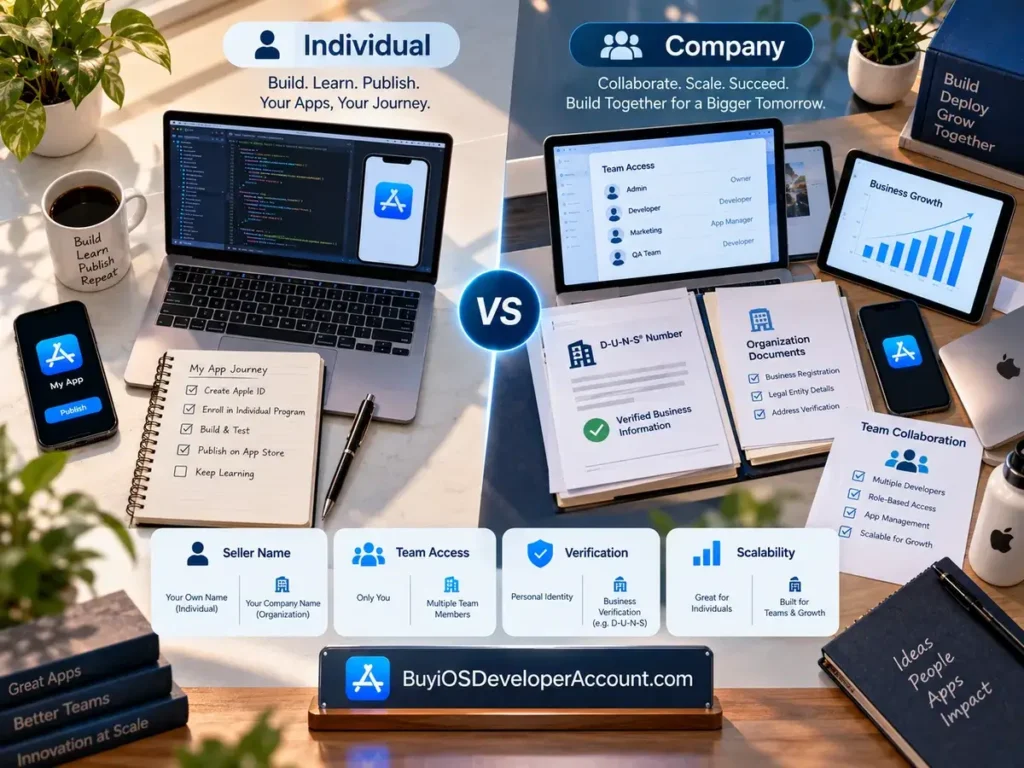
A working publishing setup requires a clear chain of responsibility. The Account Holder is the person associated with program agreements and membership renewal. App Store Connect users may be invited to perform particular jobs, but their permissions do not by themselves convey ownership of the membership. Organizations and individuals have different team arrangements, and a specific app can have its own review, distribution and commercial settings.
That distinction matters for technical tasks too. A code-signing certificate, a provisioning profile, a bundle identifier, a product page and a subscription are independent pieces of a larger workflow. Some can be changed immediately; others depend on Apple review, an agreement, financial information or account eligibility. The safest approach is to inspect prerequisites first, avoid rushing changes that are difficult to reverse and make sure every action is authorized.
For account-related requests, the official Apple Developer Program membership fee is generally US$99 per membership year, with regional payment and local-currency conditions. This is not the same as the fees of any third-party consulting or account service. For reference, BuyiOSDeveloperAccount.com publishes separate Personal ($350), Company ($850) and Combo ($1,150) package prices; these are the site’s advertised offers, not Apple’s membership prices, and the exact services, ownership and policy compliance must be evaluated independently.
Step-by-step guide: eight checkpoints
Step 1: Decide the proper app owner
For a client product, consider the client’s own organization membership with agency access instead of automatically publishing everything under the agency. Begin with the evidence you already control, and keep the original record available for comparison.
For an individual publisher, that usually means comparing the displayed status to the Apple Help instructions and saving a short note. For a company, it also means confirming the affected legal team and the person who can approve the decision.
Step 2: Separate client workspaces
Record each customer’s App Store Connect team, bundle IDs, certificates, contracts, app records and release contacts without mixing credentials. Treat this as a decision point rather than an isolated button to press.
Where possible, try the smallest reversible change first. Record the previous setting, change one variable, and check the result. That approach makes it easier to explain a failure to a colleague or Apple Developer Support.
Step 3: Request least-privilege roles
Give developers, App Managers, finance and marketing personnel the rights their assigned tasks require; avoid blanket Account Holder access. Use the official screen to separate a genuine platform restriction from a setup mistake.
A missing menu may mean the signed-in user lacks a role, the item is in the wrong status, or a prerequisite is incomplete. Test those possibilities before creating duplicate records or asking anyone to share their password.

Step 4: Manage invitations and offboarding
Use Users and Access to invite collaborators, remove departing contractors, and review permissions at project milestones. Document the expected result before changing a setting that can affect collaborators.
Write down the exact team, application and environment. A test build and a production release can behave differently, and an action taken under the wrong team can waste time even when the interface accepts it.
Step 5: Document handover procedures
Preserve source-code ownership terms, test environments, review notes, API keys and production service dependencies for client transitions. Check both the immediate task and anything that depends on the result.
An apparently successful save may still need processing, review, a fresh build or acceptance of a commercial agreement. Check the downstream result instead of relying on the first green confirmation.
Step 6: Use official app transfers where applicable
When a finished app must move to another organization, investigate Apple’s app transfer criteria rather than transferring personal Apple Account passwords. If the issue spans multiple teams, name one owner to coordinate the change.
Project handovers are especially vulnerable to ambiguity. Keep the Account Holder responsible for legal obligations while delegated staff perform technical work within their named App Store Connect roles.
Step 7: Monitor deadlines and renewals
Assign responsibility for membership renewals, tax forms, paid apps agreements and app review responses in the customer contract. Before escalating, try a controlled verification that does not expose private information.
Support requests work better with a reproducible sequence, an exact status, dates and relevant IDs. Mask personal or financial data and never send a two-factor code, Apple Account password or private certificate key.
Step 8: Create audit-ready communications
Keep a concise record of who approved a release, what changed and which legal entity is accountable for the app listing. Finish the process by checking the effect on the real app or membership.
A final validation should be reproducible by someone who was not present during setup. State what changed, where it can be checked, what still depends on Apple and the next planned review date.
A real-world decision example
Consider a small app business researching apple developer account for agencies during a busy release cycle. The team has an Account Holder, one developer, a marketing specialist and a contractor. One employee notices a problem and proposes a quick fix based on a forum message. A stronger approach is to establish the actual state of the membership or app, verify which role owns the decision, read the relevant official help page and identify a testable next step. The contractor should only receive the permission necessary for the task. The Account Holder should retain control of sensitive agreements and recovery credentials.
The team then takes one documented action, confirms the outcome in App Store Connect or the developer account and records any pending requirement. If another approval is necessary, the release plan is updated instead of promising a fixed timeline. This method applies to independent publishers too: a one-person workflow still benefits from careful checks, secure backups and clear notes.
Essential review checkpoints
- Identify the official screen or document that proves this item was completed.
- Confirm the person taking the action has the correct role and legitimate authority.
- Keep a dated record of the selected settings and why they were chosen.
- Test the resulting app or membership behavior before announcing completion.
- Prepare a rollback or support escalation route if the outcome differs from expectations.
- Make sure marketing statements match the product and Apple’s published requirements.
- Remove unnecessary account access and rotate any exposed secrets.
- Schedule a later review if the change affects renewals, billing or app updates.
Why this issue deserves a deliberate process
The most efficient workflow starts by defining the real outcome, not by clicking through an unfamiliar interface. Developers often treat an account, an app record and a finished App Store listing as interchangeable. They are separate objects with different owners, permissions, timing and verification requirements. A reliable plan asks what must change, who has authority to change it, and how success will be confirmed in the official account.
For apple developer account for agencies, this means treating “decide the proper app owner” as a verified workflow with a real owner and a defined outcome. Keep the relevant manage invitations and offboarding decision visible to everyone who may be affected. If you discover that the supporting account, role or agreement is different from what was originally expected, correct that dependency before you continue.
How to check results without assumptions
A successful click is not the same as a completed workflow. Check the resulting status, relevant emails, permissions, working builds and user-facing behavior where applicable. Record the date, the authorized operator, the screen or report checked and anything left unresolved. For payments, contracts and customer data, confirmation must come from the correct official system.
For apple developer account for agencies, this means treating “separate client workspaces” as a verified workflow with a real owner and a defined outcome. Keep the relevant document handover procedures decision visible to everyone who may be affected. If you discover that the supporting account, role or agreement is different from what was originally expected, correct that dependency before you continue.
What a successful outcome looks like
The right outcome is a documented, reproducible result owned by the correct person or organization. For example, a signed-off release, a valid app record, a confirmed renewal, an accurate user permission or a trustworthy reporting baseline is much more useful than a vague statement that the setup is complete. State the result in operational language so another team member can independently verify it.
Three details that are easy to overlook
Different teams can complete the same visible action yet reach different results because their prerequisites are different. Use the following points to check whether the workflow actually fits the reader’s case:
Separate client workspaces
Record each customer’s App Store Connect team, bundle IDs, certificates, contracts, app records and release contacts without mixing credentials. This is worth reviewing before closing the task: compare the official record, any app-level dependency and the responsible user role. Write down the evidence that would prove success instead of assuming that the original problem has disappeared.
Document handover procedures
Preserve source-code ownership terms, test environments, review notes, API keys and production service dependencies for client transitions. This is worth reviewing before closing the task: compare the official record, any app-level dependency and the responsible user role. Write down the evidence that would prove success instead of assuming that the original problem has disappeared.
Monitor deadlines and renewals
Assign responsibility for membership renewals, tax forms, paid apps agreements and app review responses in the customer contract. This is worth reviewing before closing the task: compare the official record, any app-level dependency and the responsible user role. Write down the evidence that would prove success instead of assuming that the original problem has disappeared.
Frequently asked questions
How should I handle decide the proper app owner?
For a client product, consider the client’s own organization membership with agency access instead of automatically publishing everything under the agency. The safe approach is to follow the relevant Apple documentation, use authorized account access and verify the result before taking further action. If the requirement differs by location, membership type or current status, treat the live official account as authoritative.
How should I handle separate client workspaces?
Record each customer’s App Store Connect team, bundle IDs, certificates, contracts, app records and release contacts without mixing credentials. The safe approach is to follow the relevant Apple documentation, use authorized account access and verify the result before taking further action. If the requirement differs by location, membership type or current status, treat the live official account as authoritative.
How should I handle request least-privilege roles?
Give developers, App Managers, finance and marketing personnel the rights their assigned tasks require; avoid blanket Account Holder access. The safe approach is to follow the relevant Apple documentation, use authorized account access and verify the result before taking further action. If the requirement differs by location, membership type or current status, treat the live official account as authoritative.
How should I handle document handover procedures?
Preserve source-code ownership terms, test environments, review notes, API keys and production service dependencies for client transitions. The safe approach is to follow the relevant Apple documentation, use authorized account access and verify the result before taking further action. If the requirement differs by location, membership type or current status, treat the live official account as authoritative.
How should I handle use official app transfers where applicable?
When a finished app must move to another organization, investigate Apple’s app transfer criteria rather than transferring personal Apple Account passwords. The safe approach is to follow the relevant Apple documentation, use authorized account access and verify the result before taking further action. If the requirement differs by location, membership type or current status, treat the live official account as authoritative.
How should I handle create audit-ready communications?
Keep a concise record of who approved a release, what changed and which legal entity is accountable for the app listing. The safe approach is to follow the relevant Apple documentation, use authorized account access and verify the result before taking further action. If the requirement differs by location, membership type or current status, treat the live official account as authoritative.
Can a third-party setup service guarantee the result?
No. Apple controls membership verification, platform access and App Review. A consultant may explain a documented workflow, but cannot legitimately guarantee an Apple decision or substitute for the lawful Account Holder.
Is this the same as buying somebody else’s developer account?
No. Enrollment, app management permissions and eligible app transfers are distinct from transferring another person’s Apple Account credentials. Review Apple’s Developer Program License Agreement and keep the proper owner in control.
Official Apple resources
- Topic-specific Apple documentation
- Apple Developer Program enrollment and payment
- App Store Connect documentation
- Apple Developer Program License Agreement
Final thoughts and next steps
The best way to approach apple developer account for agencies is to combine Apple’s current documentation with a secure and understandable workflow. Start from the account or app’s real status, apply each checkpoint deliberately and verify results before introducing a broader change. This reduces preventable mistakes and helps developers, founders and agencies make decisions that remain manageable when a team grows or a release is delayed.
If you are comparing third-party assistance, review the developer account information and support options and the published package details. Request a clear explanation of who legally owns the membership and what service is provided; never treat purchased credentials alone as an Apple-approved ownership transfer. The official documentation linked above should remain the source for membership eligibility, pricing, permissions and review decisions.